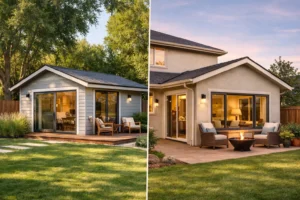
When a home starts feeling too tight, the real question usually is not whether to expand – it is how. For many homeowners, the decision comes down to adu vs room addition. Both can add usable space and long-term value, but they solve very different problems. The right choice depends on how you want to live, what your lot allows, and whether you need connected square footage or a separate living space.
In Los Angeles-area neighborhoods where property values are high and every square foot matters, this choice deserves careful planning. A well-designed project can improve daily life, support multigenerational living, or create rental potential. A poorly matched project can leave you with higher costs and a layout that still does not meet your needs.
ADU vs room addition: the core difference
An ADU, or accessory dwelling unit, is a separate living space with the features needed for independent living. That usually means a kitchen or kitchenette, a bathroom, sleeping space, and its own entrance. Depending on the property, an ADU may be detached in the backyard, attached to the home, or created through a garage conversion.
A room addition expands the primary house itself. It might be a new bedroom, a larger family room, a home office, or a first-floor suite for a family member. Unlike an ADU, a room addition is usually integrated into the main layout and functions as part of the existing home rather than as a standalone residence.
That distinction affects everything from design and permits to cost and return on investment.
When an ADU makes more sense
An ADU is often the better fit when privacy is a priority. If you need space for aging parents, adult children, long-term guests, or a tenant, a separate unit creates a level of independence that a room addition simply cannot match. People can come and go without passing through the main house, and daily routines stay more comfortable for everyone.
ADUs also appeal to homeowners who are thinking beyond immediate space needs. A detached unit can serve one purpose now and another later. It may start as a home office or guest house, then become housing for family, and eventually provide rental income. That kind of flexibility is a big reason so many homeowners look at ADUs as both a lifestyle upgrade and a property strategy.
There is a trade-off, though. Because an ADU functions like a small home, it usually requires more infrastructure. You may need a kitchen, additional plumbing, electrical upgrades, separate utility considerations, and more involved site planning. Construction is more complex than adding a single room, even if the finished square footage is modest.
When a room addition is the better choice
A room addition is usually the stronger option when your goal is to make the main house work better. If your family needs another bedroom, a larger kitchen footprint, an expanded primary suite, or a playroom connected to everyday living areas, an addition keeps everything under one roof.
This option often feels more natural for households that do not need a separate residence. Parents with young children, for example, usually want extra bedrooms nearby rather than across the backyard. Homeowners who love their existing layout may also prefer an addition because it enhances the home they already use every day instead of creating a second structure.
Room additions can also be more straightforward from a design standpoint. Since the new space ties into the existing home, the project can be shaped around current circulation, materials, and architectural style. When done well, it feels like it was always part of the house.
The trade-off is that a room addition does not offer the same level of privacy or future rental potential as an ADU. It adds space, but it does not create an independent living unit.
Cost depends on more than square footage
Homeowners often assume a room addition is always cheaper than an ADU, but that is not automatically true. Cost depends on scope, site conditions, structural work, utility access, finishes, and permit requirements.
A basic room addition without a kitchen or major plumbing is often less expensive per project than building a fully functional ADU. That said, if the addition requires major foundation work, roofline changes, structural reinforcement, or a complicated tie-in to the existing house, costs can climb quickly.
An ADU usually comes with a higher starting point because it includes more systems and more complete living functions. Even a smaller unit may need a bathroom, kitchen, HVAC planning, insulation upgrades, and dedicated entries. But because it can serve as housing, an ADU may offer a different kind of value over time.
This is why early planning matters. A reliable contractor should walk you through realistic costs based on your property rather than giving broad numbers that do not reflect your site.
Permit and zoning considerations
Permits are part of both project types, but the path is not identical. Room additions are reviewed as expansions of the primary residence, so city approval focuses on setbacks, lot coverage, height limits, structural plans, and whether the new space meets building code.
ADUs come with their own set of state and local rules. In California, ADU laws have made these projects more accessible, but that does not mean they are simple. Site constraints, utility connections, access, fire safety, and property-specific regulations still matter. Detached ADUs and garage conversions can each bring different requirements.
For homeowners, the practical takeaway is simple: both projects need careful permit handling, and neither should be treated casually. In older Los Angeles homes especially, hidden conditions and city requirements can shape the design more than people expect.
How each option affects daily life
The best remodeling decision is not just about appraised value. It is about how the space will function on a normal Tuesday.
If you add a room to the main house, construction may affect your daily routine more directly because the work connects to occupied living areas. There may be temporary disruptions to walls, hallways, roofing access, or adjacent rooms. Once complete, though, the added square footage blends into your home life in a very direct way.
With an ADU, the construction zone is often more contained if the unit is detached or built from an existing garage. That can reduce some interior disruption, although backyard access, utility trenching, and staging still affect the property. After completion, the benefit is separation. That separation can feel like a luxury if the goal is privacy, quiet, or independent use.
Resale value and long-term return
Both project types can add value, but not in exactly the same way.
A room addition often improves value by increasing the livable square footage of the main home and making the floor plan more attractive to future buyers. Adding a bedroom, bathroom, or expanded primary suite can strongly improve market appeal, especially when the existing house feels undersized.
An ADU may attract buyers for different reasons. Some see it as a flexible family solution. Others see income potential or a separate workspace. In high-demand markets, that versatility can be a major selling point.
Still, return is not automatic. The design needs to make sense, the finishes should fit the home, and the project must be permitted and built correctly. A disconnected layout or low-quality construction can weaken the upside of either choice.
Questions to ask before you choose
If you are deciding between adu vs room addition, start with your actual use case rather than the trend. Ask yourself whether you need independent living space or simply more room inside the main house. Think about who will use it in two years, not just this season.
It also helps to consider your lot size, access, parking conditions, and budget comfort level. A detached ADU may sound ideal until site limitations make it expensive. A room addition may seem simpler until the existing layout forces a costly structural redesign.
This is where design-build guidance can save time and money. A team that handles design, planning, permits, and construction together can identify constraints early and help you compare realistic paths instead of rough ideas. That is often the difference between a smooth project and a frustrating one.
For some homeowners, the answer is clear from the start. For others, it takes a property review and a few smart plan options to see which investment fits best. Level Up Contractor helps homeowners work through those choices with clear estimates, practical design guidance, and start-to-finish oversight.
If your home needs more space, the smartest next step is not picking the bigger project. It is choosing the one that solves the right problem for the way you live.